The Nexus of State Sovereignty and Federal Enforcement in the Digital Age
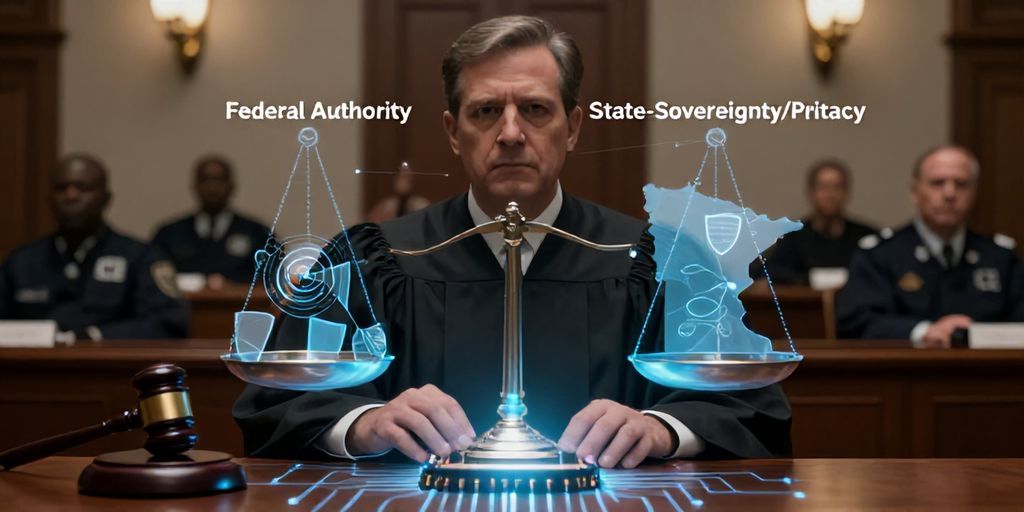
A recent federal court order mandating a new briefing by Wednesday has intensified scrutiny on the operational conduct of U.S. Immigration and Customs Enforcement (ICE) in Minnesota. At the heart of the matter is a critical question posed by the judge: whether the Department of Homeland Security (DHS) is employing armed raids as a coercive tactic to pressure Minnesota into abandoning its sanctuary policies, thereby potentially subjecting the state to illegal punishment. This legal and political standoff transcends traditional jurisdictional disputes, delving deep into the complexities of data sovereignty, digital privacy, and the technical challenges faced by states attempting to uphold distinct policy frameworks in an increasingly interconnected enforcement landscape.
From a cybersecurity perspective, this case illuminates the inherent tension between federal mandates for national security and immigration enforcement, and a state's prerogative to establish policies that protect its residents, including those regarding data sharing and collaboration with federal agencies. The judge's inquiry into 'illegal punishment' forces a re-evaluation of not just the legality of ICE's tactics, but also the broader implications for digital rights and the architectural integrity of state-level data systems.
Legal Battleground: Punitive Measures and Digital Reconnaissance
The judge's decision to delay an immediate ruling, instead demanding further legal arguments, underscores the profound constitutional implications of this dispute. If DHS is indeed leveraging armed raids to coerce a state, it represents a significant challenge to the principles of federalism and the Tenth Amendment. However, in the 21st century, 'punishment' extends beyond physical enforcement; it encompasses the strategic deployment of digital resources and intelligence gathering.
The pressure exerted on sanctuary states can manifest not only through high-profile physical operations but also through more subtle, yet equally potent, forms of digital reconnaissance and data exploitation. Federal agencies possess sophisticated capabilities to gather intelligence, analyze digital footprints, and potentially circumvent state-level data protections, raising questions about the true efficacy of sanctuary policies in an era of pervasive digital surveillance.
Data Flow, Surveillance, and Privacy Concerns in Sanctuary Jurisdictions
Sanctuary policies are fundamentally about limiting state and local cooperation with federal immigration enforcement, often including restrictions on data sharing. This creates a complex technical challenge: how can a state effectively firewall its data and its residents' information from federal access when both entities operate within the same national digital infrastructure?
- Data Segregation Challenges: States and municipalities must implement robust technical controls to segregate data that could identify individuals for immigration enforcement purposes. This often involves complex database architectures, access control lists, and audit trails to prevent unauthorized data access or transfer.
- Open-Source Intelligence (OSINT) and Public Records: Even without direct access to state databases, federal entities possess sophisticated capabilities for OSINT and broader digital surveillance. Public records, social media, and commercially available data sets can be aggregated and analyzed to build profiles.
- Digital Footprints and Metadata: Every online interaction leaves a trace. Simple tools, exemplified by services like iplogger.org, demonstrate how readily accessible IP addresses and other metadata can be logged and correlated. While iplogger.org itself is a general-purpose IP tracking tool, its existence highlights the broader landscape of digital tools that can be repurposed to map digital footprints, monitor online activity, and potentially identify individuals. This capability underscores the challenge for sanctuary states: even if they refuse direct data access, the digital realm offers alternative vectors for intelligence gathering, raising profound questions about the sanctity of individual privacy in an era of ubiquitous digital presence.
The legal and technical frameworks governing data sharing become a critical battleground. The potential for federal agencies to gather intelligence through indirect means poses a significant threat to the spirit, if not the letter, of sanctuary policies, compelling states to consider advanced privacy-enhancing technologies (PETs) and strict data governance models.
The Digital Frontier of Immigration Enforcement
Modern immigration enforcement increasingly relies on advanced technologies, including facial recognition, biometric data analysis, and predictive analytics. The integration of these tools into federal operations creates new vectors for data collection and identification, potentially bypassing traditional state-level data restrictions. For individuals residing in sanctuary states, this raises profound ethical and privacy concerns: are their digital identities inherently vulnerable to federal scrutiny, regardless of state protections?
Furthermore, the interoperability of various law enforcement databases, even those not directly managed by state immigration authorities, can inadvertently create pathways for federal agencies to access information. This necessitates a holistic approach to data security and privacy, extending beyond explicit data-sharing agreements to encompass all potential data leakage points.
Technical Safeguards and Policy Responses for Sanctuary States
To effectively uphold sanctuary policies in the face of federal pressure, states and local jurisdictions must implement robust technical and policy countermeasures:
- Data Anonymization and Pseudonymization: Implementing techniques to strip personally identifiable information (PII) from data sets before any potential sharing or access, or replacing it with pseudonyms.
- Strict Access Controls and Data Enclaves: Designing secure data architectures where sensitive information is stored in isolated enclaves with granular access controls, ensuring only authorized personnel for specific, legal purposes can access it.
- Secure Multi-Party Computation (SMC): Exploring advanced cryptographic techniques that allow multiple parties to jointly compute a function over their inputs while keeping those inputs private. This could enable limited, privacy-preserving data analysis without revealing raw data.
- Legal and Policy Firewalls: Establishing clear legal prohibitions and internal policies against voluntary cooperation or data sharing that could facilitate immigration enforcement, backed by strong legal counsel.
- Privacy Impact Assessments (PIAs): Regularly conducting PIAs for all data systems that might contain resident information, especially those that could intersect with federal requests.
The Broader Implications for Digital Rights and Federalism
The Minnesota ICE decision is more than just a localized legal skirmish; it is a bellwether for the future of federalism in a digitally hyper-connected world. The judge's deliberation on 'illegal punishment' will set important precedents for how federal agencies can interact with states that adopt divergent policies, particularly concerning the digital identities and privacy of residents.
This case forces a critical examination of where the boundaries of federal authority lie when states assert their sovereignty over data and privacy. It underscores the urgent need for robust legal frameworks and advanced technical solutions to protect individual rights in an era where digital surveillance capabilities are constantly evolving.
Conclusion: Awaiting a Digital and Legal Resolution
As the federal judge awaits new briefings, the outcome of the Minnesota ICE decision will have far-reaching implications. It will not only shape immigration enforcement practices but also redefine the parameters of state data sovereignty, digital privacy, and the balance of power between federal and state governments. For cybersecurity researchers and policy makers, this case serves as a poignant reminder that legal battles increasingly play out on a digital stage, demanding innovative technical solutions alongside astute legal arguments to safeguard civil liberties and constitutional principles.